Summer schedule: 9AM Sunday School, 10AM refreshments, and church fellowship meals take a break in July & August. Please join us for Worship Service, which is still held every Sunday at 10:30 AM!

Category: Bible

  • Go Back and Go Forward

    Go Back and Go Forward

    Some Poignant Counsel

    Shortly before getting married, I received poignant counsel about something to expect in marriage. A friend told me that, in the beginning, marriage to my wife was going to feel overwhelmingly exciting; everything would feel new, unbelievable, and thrilling. But, as I continued in relationship with my wife, this feeling would change: not diminishing, exactly, but transforming. There would be less of a feeling of novel excitement and more of a feeling of familiar satisfaction. And while this latter feeling would not be as “loud” as the beginning feeling, it would be deeper. Ultimately, if I continued pursuing my wife in love through the years, the marriage would only get richer.

    Though my wife and I have only been married eleven years, this advice has proved correct. Ema and I can testify that we love and enjoy each other more now than we did on our wedding day. It’s true that we’re past the “honeymoon period” where everything is rose-colored and neither spouse can do any wrong. But it’s actually in facing the trials of life together, ministering together, learning how to deal with conflict biblically, learning about each other, repenting toward and forgiving each other, and becoming more sanctified together that our relationship has deepened and sweetened.

    Recovering First Love

    I mention the above because I have been thinking more about what Pastor Babij preached from Revelation 2:1-7: how Christians can leave their “first love” for Christ and how they need to remember and return. Perhaps you think back to your own beginning days as a Christian with bittersweetness. “Yes,” you think, “I was so joyful in the Lord at that time, seeking him diligently in the word, prayer, and church and eager to serve in any way that was available. But how can I go back to that state after all that’s taken place since then? After all the trials, hurts, and disappointments? After the many new obligations I’ve taken on in my life as a worker, married person, or parent? The innocent enthusiasm I once had as a new Christian is gone, so how can I ever return to those joyful days of first love?”

    In recovering your first love for Jesus, it’s true that you cannot go back to the same life circumstances you once had or the spiritual naivety you once held—nor should you. But you can and must go back to the fundamental attitude of a new Christian: of seeking Jesus, God Himself, as your true life and ultimate treasure (Mt 10:37-39; Ps 16:2). Just as, in some ways, spouses who have drifted apart must remember and return to the commitment of love they expressed to one another before God when they first got married (Eph 5:22, 25), so backslidden Christians must remember and return to what the Christian life is all about: worshipping the Lord and walking before him in grateful obedience (Gal 2:20).

    Maturing in Love

    Yet the Christian life is not merely about maintaining a level of first-time devotion to Jesus but of growing deeper in relationship with him. The very aspects of our world that we so often use as excuses to neglect a relationship with Jesus—our trials, our obligations, and even our sins—these become opportunities for us to mature in love for Jesus and actually enjoy him more. As you put the Lord first, relying on him in your trials (Heb 4:16), prioritizing him amid your obligations (Mt 6:33), and by faith repenting and believing in his forgiveness for your sins (1 Jn 1:9), you arrive at a place of deeper love and appreciation for him than even when you first believed. After all, the Bible not only commands that we repent and return, but also that we progress (Phil 3:12-17; Eph 3:14-19).

    I think specifically of something the apostle John writes in 1 John 2:13c-14,

    I have written to you, children, because you know the Father. I have written to you, fathers, because you know Him who has been from the beginning. I have written to you, young men, because you are strong, and the word of God abides in you, and you have overcome the evil one.

    In these verses, John addresses Christians at different levels of spiritual maturity rather than physical maturity. What especially stands out to me is the similarity and difference between spiritual children and spiritual fathers as stated by John: children “know the Father,” but fathers “know Him who has been from the beginning.” Both children and fathers fundamentally “know” God, yet the fathers’ knowledge is deeper.

    And we’re talking about relational, not merely intellectual knowledge here. It’s not that the fathers are simply more well rehearsed in doctrine than spiritual children but that the fathers actually have come to know God in relationship more intimately. We Christians should, of course, desire the same for ourselves and all people: not merely that they would come to know God but know and enjoy him more deeply. Such is the essence of worship (Ps 67:1-7; Jer 9:23-24; Jn 17:3).

    Conclusion

    So then, as we consider Revelation 2:1-7, let us indeed believe the gospel again, recover the heart of “first love,” and do the fundamental deeds consistent with knowing God. Yet let us also go forward in the midst of our difficult and harried lives to grow in knowledge of Jesus and love for him so that we might experience more and more his eternal life.

    Questions to Consider:
    1. Did you once have a heart of greater love and zeal for Jesus than you have now? What steps can you take to get back to that fundamental stance?
    2. Has your love for Jesus deepened over time? Why or why not?
    3. In 1 John, John links love for God with love for others. Has your love for others also deepened over time? Why or why not?

  • Just Going through the Motions

    Just Going through the Motions

    I used to be an avid American football fan, but there was one football game each year that I could not bring myself to watch: the Pro Bowl. In the Pro Bowl, the top players of each of the NFL teams are brought together onto two different teams to play against each other in a kind of all-star match. In theory, the Pro Bowl ought to be one of the most exciting games of the year; after all, the best of the best are all playing with and against each other!

    But in practice, the Pro Bowl usually inspires nothing more than a long yawn. The players are not used to playing with each other, they don’t want to injure themselves as they prepare for their real team’s next season, and they have no reason to exert themselves since the outcome of the Pro Bowl does not matter. So the players mostly just goof around and go through the motions. Many football fans as well as players routinely complain about the boring, pointless Pro Bowl.

    We can understand why NFL players might not try hard in the Pro Bowl, but imagine if they took the same attitude into a regular NFL game or even the Super Bowl: skipping practice, putting bare minimum effort in the game, and above all trying to avoid anything painful or risky. Would we not be dismayed and outraged if such a player were playing for our team? And rightly so. After all, how can someone just go through the motions when a game really does matter and when your fans, your fellow players, and your coach are all counting on you? People would rightly question the love of such a player: his love for the sport, his love for those relying on him, and his love for victory.

    There is, of course, a parallel in the Christian life, as Pastor Babij showed us on Sunday from the book of Malachi. It is totally possible for Christians to go through the motions of the Christian life without any real love or passion. Activities meant to cultivate a love for God and others—the spiritual disciplines of the Bible, prayer, and church—can become boring activities which the Christian neglects or just shuffles through. Even ministry and evangelism can become more about checking off boxes of obligation than about seeing souls saved or God’s glorious name magnified.

    Therefore, as Pastor Babij preached Sunday, it is important for Christians to routinely examine themselves before God in the Scriptures and ask themselves, “Why am I doing this? What is my life all about? Is what I’m doing going to be worth it in the end?” If love for God and others is not at the center of our being (Dt 6:5; 1 Cor 13:1-3; 1 Jn 4:8), and if the joyful expectation of eternally satisfying reward in God is not our core motivation (Ps 17:15; Jn 17:3; Heb 11:6), then we will end up hypocritically just going through the motions like Israel frequently did. We will seem to get little out of our spiritual disciplines, and our obedience and service to the Lord will be noticeably incomplete (Mal 1:12-13; Rev 2:4-5). Not to mention, we will be unhappy (Jer 2:13). However, if we are driven by love for God and others to cultivate our love and seek God’s reward, then not only will we be found pleasing to God, but we will also find what we are seeking and be satisfied (Ps 63:1-5; Mt 5:3-12).

    The book of Malachi closes with these poignant words to move us to remember what we and our lives ought to be all about in the first place:

    Malachi 3:16-18, Then those who feared the LORD spoke to one another, and the LORD gave attention and heard it, and a book of remembrance was written before Him for those who fear the LORD and who esteem His name. “They will be Mine,” says the LORD of hosts, “on the day that I prepare My own possession, and I will spare them as a man spares his own son who serves him.” So you will again distinguish between the righteous and the wicked, between one who serves God and one who does not serve Him.

    Questions to Consider:
    1. Is love at the center of your spiritual disciplines, obedience, and ministry?
    2. If you have moved away from love for God and others, what do you need to remember about the Lord to return to love?
    3. How can you ensure that your efforts at cultivating love for God do not simply become a matter of going through the motions?

  • Cultivating Love for Jesus

    Cultivating Love for Jesus

    Something from Pastor Babij’s Sunday sermon that stood out to me was his statement about cultivated love: the real tragedy in a relationship is not a lack of love but a failure to cultivate love. How true this is!

    As a biblical counselor, I am amazed how much cultivation of love or lack thereof impacts a marriage: when two people who do not love each other take purposeful and practical steps to cultivate their love, their relationship is gradually transformed, and real love and sweetness return! Conversely, when two people who are in love do not take purposeful and practical steps to cultivate their love, their relationship gradually decays until there is no love left. The same is true of our relationship with the Lord Jesus. Our love for him is always either growing or decaying based on whether we are cultivating love for him. But how does one purposefully and practically cultivate love for Jesus?

    The Discipline of Love

    I am interested to hear how Pastor Babij will answer the above question over the next couple weeks. In the meantime, though, considering how to cultivate love for Jesus reminds me of our series on the disciplines of grace. Paul writes in 1 Timothy 1:5, in connection with his command for Timothy to continue to lead the church at Ephesus and forbid unprofitable teaching:

    But the goal of our instruction is love from a pure heart and a good conscience and a sincere faith.

    Paul saw love—and probably meaning both love for Christ and love for others, here—as the goal and end result of sound teaching. Therefore, if someone wanted to cultivate love, surely one practical way to do so would be to devote oneself to the apostolic word! Furthermore, Paul and the writer of Hebrews mention love as an end result of prayer and gathered fellowship (Phil 1:9-10; Heb 10:24-25). Indeed, each of the spiritual disciplines are key for cultivating love for Jesus. Though there is pain and self-denial involved in pursuing Jesus these ways (1 Tim 4:7-10), the end result is indeed “love from a pure heart and a good conscience and a sincere faith.”

    The Loop of Love

    One of the most marvelous aspects of growing love is that it encourages its own growth by a kind of positive feedback loop. As one does the hard work of cultivating love, he begins to experience greater delight in the object of his love, which encourages him to cultivate his love further. For example, when a husband chooses to deny himself for the sake of loving his wife in a certain way and experiences her appreciation, that husband’s love for his wife not only grows, but he himself is also more motivated to show her further love. In a similar way, as we cultivate love for Jesus and experience more the joy, peace, and life that he promises are in him (Jn 10:10; 14:27; 15:11), we not only love him more but find more motivation to pursue him and cultivate our love for him.

    Yet the opposite can also be true. In a marriage where love is not cultivated, every undealt-with hurt, misunderstanding, or instance of neglect only encourages husband and wife to further withdraw from each other and no longer cultivate love. In the same way, our yielding to sin, believing lies about the Lord, or refusing to cultivate love for Him drives us further away from Christ and all the blessings in him that should normally motivate us to seek him. It’s like we see less and less of his beauty, smell less and less of his fragrance, and feel less and less of his touch. Truly, he is not the one changing (2 Tim 2:13); it is only our perception and experience of him. Yet what a dangerous state to be in! The Bible’s frequent description of this negative feedback loop is the “hardening of heart.” As the heart hardens, it becomes more callous with sin, more unfeeling of the Lord’s grace, and more in danger of the Lord’s discipline and judgment (Heb 3:12-13).

    Conclusion

    I chose the name “Disciplines of Grace” for my sermon series because I wanted to emphasize that the spiritual disciplines are both grace-fueled and grace-seeking. We do not discipline ourselves for godliness out of mere duty or to earn salvation, but, instead, because we have experienced the Lord’s grace and want to know that grace further. Well, I think we could just as accurately refer to spiritual disciplines as “Disciplines of Love.” Because we have experienced the Lord’s love in Christ (Rom 5:5) and because we want to grow in our own love for him and in the knowledge/experience of his love (Eph 3:18-19), we discipline ourselves for godliness. May we, therefore, earnestly seek to cultivate love for Christ by devotion to his word, prayer, and the gathered fellowship.

    Questions to Consider:
    1. Is your love for Christ growing or decaying? Why?
    2. What practical actions are you taking in your life right now to cultivate love for Jesus? Are they working?
    3. How is cultivating love for Jesus intimately tied to cultivating love for others?

  • Songs Celebrating Church Unity

    Songs Celebrating Church Unity

    On Sunday, we looked at Psalm 133, a psalm that encourages us to seek and celebrate the united gathering of God’s people as the place of blessing. Considering, though, that Psalm 133 is a model prayer-song, we might ask whether Christians have indeed followed the psalm’s model and made more music that praises God for church unity. God’s people have indeed done so! For today’s meditation, then, I’d like to present you with three Christian hymns in the same vein as Psalm 133.

    Oh, How Good It Is, by Keith Getty, Kristyn Getty, Russ Holmes and Stuart Townend, 2014
    (YouTube, see Stuart Townend’s explanation here).

    1 Oh how good it is when the family of God
    Dwell together in spirit, in faith and unity;
    Where the bonds of peace, of acceptance and love
    Are the fruits of his presence here among us.

    Chorus: So with one voice we’ll sing to the Lord,
    And with one heart we’ll live out his word
    Til the whole world sees the Redeemer has come,
    For he dwells in the presence of his people.

    2 Oh how good it is on this journey we share
    To rejoice with the happy and weep with those who mourn.
    For the weak find strength, the afflicted find grace,
    When we offer the blessing of belonging.

    3 Oh how good it is to embrace his command
    To prefer one another, forgive as he forgives.
    When we live as one we all share in the love
    Of the Son with the Father and the Spirit.

    Blessed Be the Tie that Binds, By John Fawcett, 1782
    (YouTube example)

    1 Blessed be the tie that binds
    Our hearts in Christian love;
    The fellowship of kindred minds
    Is like that to that above.

    2 Before our Father’s throne
    We pour our ardent prayers;
    Our fears, our hopes, our aims are one
    Our comforts and our cares.

    3 We share each other’s woes,
    Our mutual burdens bear;
    And often for each other flows
    The sympathizing tear.

    4 When we asunder part,
    It gives us inward pain;
    But we shall still be joined in heart,
    And hope to meet again.

    5 This glorious hope revives
    Our courage by the way;
    While each in expectation lives,
    And longs to see the day.

    6 From sorrow, toil and pain,
    And sin, we shall be free,
    And perfect love and friendship reign
    Through all eternity.

    I Love Thy Kingdom, Lord, by Timothy Dwight, 1800
    (YouTube example)

    1 I love thy kingdom, Lord,
    the house of thine abode,
    the church our blest Redeemer saved
    with his own precious blood.

    2 I love thy church, O God:
    her walls before thee stand,
    dear as the apple of thine eye
    and graven on thy hand.

    3 For her my tears shall fall,
    for her my prayers ascend;
    to her my cares and toils be giv’n,
    ’til toils and cares shall end.

    4 Beyond my highest joy
    I prize her heav’nly ways,
    her sweet communion, solemn vows,
    her hymns of love and praise.

    5 Jesus, thou Friend divine,
    our Savior and our King,
    thy hand from ev’ry snare and foe
    shall great deliv’rance bring.

    6 Sure as thy truth shall last,
    to Zion shall be giv’n
    the brightest glories earth can yield,
    and brighter bliss of heav’n.

    Questions to Consider:
    1. Why is singing together about unity in Christ particularly appropriate?
    2. Do you cherish the church the way that Christ and his people in the Bible do? If not, why not?
    3. How can you contribute to your church’s unity in Christ so that the unity is even more worth celebrating?

  • The Order of the Psalms

    The Order of the Psalms

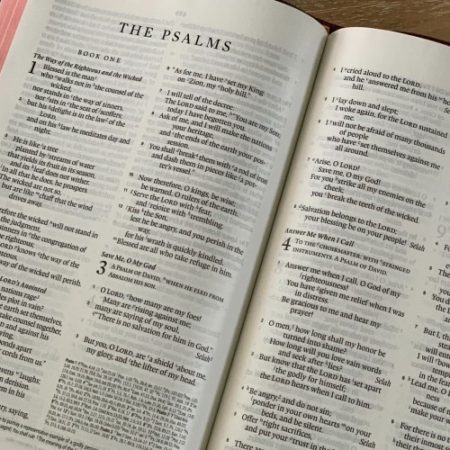
    One unique aspect of studying the Psalms is the self-contained nature of each psalm. After all, the different psalms were composed by different people on different occasions and only later assembled into a collection of worship songs for Israel (the collection covers approximately 1410-450 BC). Each psalm is an independent work, so it’s like the Psalms are a mini book collection within the greater book collection we know as the Bible. Therefore, while other books of the Bible require special attention to the preceding and proceeding context of each chapter to understand the author’s main point, you do not need to pay attention to the before and after context of each psalm to understand and appreciate the meaning. Or do you?

    Clues of Order

    While it’s true that the psalms are largely self-contained works, their order in the book of Psalms is not random. There are actually signs of purposeful arrangement throughout the Psalms: the Psalms are divided into five books, with each book ending with a doxology (Ps 41:13; 72:18-20; 89:52; 106:48; 150:6); there are labeled groups of psalms at different places in the book (e.g. The Songs of Ascents, Ps 120-134; the Psalms of Asaph, Ps 73-83); and there are also some psalms that clearly connect together in subject matter (e.g., the Messianic psalms of Psalms 22-24 or the psalm pairs connecting God’s word and God’s Messiah, Ps 1-2; 18-19; 118-119). In fact, there appears to be a general progression of subject matter over the course of the Psalms, as I outline below.

    A Proposed Order

    Of course, once one recognizes a purposeful arrangement, the question raised is “Why?” Why five books? Why this particular arrangement and not a different one? The answer in specific cases is not always clear, but Bible teachers have suggested a couple of answers for the general order of the Psalms at least:

    1. The five books of the Psalms reflect the five books of another key part of the Bible: the Torah. Just as Israelites were to devote themselves to the law of Moses, so they were to devote themselves to this “second Torah” in their pursuit of God.
    2. The five books of the Psalms correspond generally to the experience of Israel and its Davidic king. To borrow my seminary professor’s labels for each book:

    • Confrontation: Book 1 (Psalms 1-41) features many psalms of struggle written by David and reflects the conflict Israel experienced as David established his divinely ordained rule.
    • Communication: Book 2 (Psalms 42-72) features psalms involving nations outside of Israel, reflecting David’s victory over his enemies and Israel’s expanded influence toward the nations. The international name for God, “Elohim,” is used much more frequently than “Yahweh” in this book.
    • Devastation: Book 3 (Psalms 73-89) reflects Israel’s devastation by foreign nations and the Davidic king’s crown cast into the dust. All of the exilic psalms poignantly appear in this book.
    • Maturation: Book 4 (Psalms 90-106) reflects a matured Israel returned from exile, with many psalms affirming God’s sovereign rule and the future establishment of God’s kingdom.
    • Consummation: Book 5 (Psalms 107-150) features many psalms of praise and eschatological blessing. This book reflects the climax of redemptive history: the joyful establishment of the kingdom of God on earth and the accomplished redemption of Israel.

    Conclusion

    Recognizing this general arrangement of the Psalms does not greatly affect the interpretation of any particular psalm but does deepen your understanding and help you appreciate specifically how the Psalms reflect both the history and future of the people of God. For example, Psalm 24, the psalm we examined together last Sunday, fits within the general section of Confrontation related to David’s kingship. But just as Yahweh once subdued David’s enemies and entered Jerusalem as a conquering king, so the Davidic King to come will also battle the nations in the power of Yahweh and march victoriously into Jerusalem.

    But who will enter in with the king of glory on that future day and dwell in his presence? The same kind of person originally outlined in David’s day. May we be counted as such people!

    Psalm 24:3-5,
    Who may ascend into the hill of the Lord?
    And who may stand in His holy place?
    He who has clean hands and a pure heart,
    Who has not lifted up his soul to falsehood
    And has not sworn deceitfully.
    He shall receive a blessing from the Lord
    And righteousness from the God of his salvation.

    Questions to Consider:
    1. Why does the book of Psalms begin with Psalms 1 and 2?
    2. There is still some variety within each book of the Psalms. What might be the purpose behind this variety?
    3. Have you ever considered both the historical and eschatological nature of many psalms? How might this change the way you understand and pray the psalms?

  • Has God Answered My Prayer? Part 2

    Has God Answered My Prayer? Part 2

    How do you know if God has answered your prayer?

    In last week’s blog post, we saw that one error we can fall into as Christians is to believe that God has answered our prayer and given us the good for which we have asked when he hasn’t. Circumstances might line up in remarkable ways after we pray for something, but such does not necessarily mean we have God’s provision (yet). We must investigate further to see if what has appeared in our lives after prayer actually aligns with God’s will as expressed in the Bible.

    This week, we’ll consider the opposite error: believing we don’t have an answer to prayer from God when, in fact, we do.

    Just a Coincidence?

    Sometimes we might pray for something, and then, when we receive it, we doubt that God has actually provided that good thing in response to our prayer. For example, you might pray that your friend would recover from illness, and then, when your friend does recover, you say to yourself, “Well, did God really act in answer to my prayer? I mean, my friend was already starting to feel better, and most people recover from illness even without prayer. So, who’s to say that God did anything? Maybe my friend’s recovery after my prayer was just a coincidence.”

    Unfortunately, we humans never get do-overs for specific situations in life. This means that, when it comes to prayer, there is no way for us to test in a given situation what would have happened if we had prayed or not prayed. How can we ever be certain, then, that receiving what we prayed for is God answering and not just some happy but non-supernatural coincidence?

    There is only one answer: the Bible! We Christians have come to know that the Bible is the true and divine word (1 Thess 2:13), and God tells us in his Bible that he acts to give his people good in response to prayer (Mt 7:7, 11). Therefore, when you receive the good for which you have asked in prayer, you can know on the authority of God’s word that what you have received is not coincidence but the loving hand of your Father. And after all, is anything really a coincidence when the whole universe is sustained by God’s command (Heb 1:3; Ps 104:1-35)?

    As to whether God still would have provided a specific good thing without prayer: that we cannot know. What we do know is that God invites us to participate by prayer in bringing about his good will and that, sometimes, we miss out on his good because we do not pray (James 4:2-3; 5:16-18). Ultimately, faith in God and his promises is how we know that God answers our prayers.

    Painful but Good Providence

    Actually, faith in God and his promises is also how we know that God has answered our prayer when the outcome of a situation is painful. Let’s pretend again that you pray for your friend to recover from illness, but, contrary to your expectation and desire, your friend does not get better, but worse, and even passes away. Surely this kind of situation is an example of God not answering your prayer and not giving you the good thing for which you have asked…or is it?

    One of the prayer principles from the Bible I emphasized in Sunday’s sermon is our need to pray biblically. We must pray according to the truth of the Bible and in the way the Bible itself teaches us how to pray. This means not only that we should pray variously, reverently, boldly, persistently, and innocently, as we discussed on Sunday, but also that we should recognize the greatest goods we are after in prayer.

    Ultimately, if we are praying rightly, we are not simply after pleasant circumstances but God’s glory and that which leads to the lasting soul-profit of people (Ex 33:18; John 17:3; Phil 3:8-14; Ps 119:71). We do not always know how these two great goods might be best achieved. Therefore, when we pray, we ought to pray with the heart understanding and even the spoken admission, “My God, glorify yourself in this situation and do your people true good, even if it’s not in the way I prefer. Not my will, but your will be done.” (cf. Jn 12:27-28; Mt 26:39; Phil 1:19-20)

    When these high-level prayers (for God’s glory and his people’s eternal good) surround and permeate low-level prayers (for specific needs and desires in our world), we can know that God always answers our prayers. For God has sworn always to glorify himself and do his people good (Ps 46:10; Isa 42:8; Rom 8:28-30). Even when a specific answer is painful and the opposite of what you express desire for in an earthly sense—like God taking instead of healing a loved one—you actually still have the two greater goods for which you prayed. You may not be able to see or understand how the particular answer from God glorifies him and does you and others good, but you can still know it. How? By faith: faith in God’s good character and in God’s sure word.

    Conclusion

    True Christian faith will always stand out in the world, even when it comes to prayer. The world may see the pleasant circumstances we experience after prayer as mere coincidence and the painful circumstances we experience after prayer as proof of God’s apathy or non-existence. They may therefore see us as naïve and ridiculous in our devotion to prayer. But we see reality clearly because of God’s trustworthy word. We know both that our God is in the heavens and does whatever he pleases (Ps 115:3) and that God is pleased to always answer his people’s prayers (Jn 16:23-24, 26-27). By faith we trust that our God always answers our prayers with good. We don’t want to misunderstand that good by using prayer to justify foolishness, but, certainly, we want to worship him for that good and give him thanks (1 Thess 5:18).

    Psalm 84:11, For the LORD God is a sun and shield;
    The LORD gives grace and glory;
    No good thing does He withhold from those who walk uprightly.

    Questions to Consider:
    1. Do you give God glory for gracious circumstances and answered prayer, or do you attribute the good you experience to yourself and mere coincidence?
    2. Have you struggled to see a specific answer to prayer from God as good? How does your perspective need to change (Eccl 3:11, 14; Mt 23:12; 2 Cor 12:7-10)?
    3. How might God’s refusal to regard the request of someone walking in sin (Ps 66:18) or to provide something desirable before the proper time (Hab 2:3-4) be considered a “good answer” to prayer?

  • Has God Answered My Prayer? Part 1

    Has God Answered My Prayer? Part 1

    As I’ve thought more about the messages on prayer over the last two weeks, I found myself also considering this question: how do I know when God has answered my prayer? Perhaps the answer to that question seems so obvious that you’ve never even bothered to ask the question. However, if we’re not careful, we can easily conclude that God has answered prayer when he hasn’t or that God hasn’t answered prayer when he has. By “answered prayer,” of course, I mean that God has indeed given us the good thing for which we have asked (Mt 7:11).

    Sometimes we can conclude that we have our answer to prayer from God when we actually don’t (yet). For example, perhaps we pray for a house, spouse, or job, and then something notable happens in our lives related to that prayer: we visit a promising home listing, we hit it off with someone attractive, or we receive an unexpected job offer. We can be easily tempted to think, “This can’t be a coincidence; this must be the one! This is God’s perfect provision and answer!”

    Certainly it is good for us to pray expectantly, even that God can answer extravagantly and immediately, but we should also remember Proverbs 20:25,

    It is a trap for a man to say rashly, “It is holy!”
    And after the vows to make inquiry.

    Before we simply give God thanks and proceed forward with God’s “answer” to our prayer, we should find out whether what we see really is at it appears and whether pursuing it agrees with God’s commands and wisdom. Perhaps, upon further investigation, we find that the promising home doesn’t actually fit in our budget (cf. Prov 24:27; Lk 14:28-30), or that the potential spouse is only a nominal Christian (cf. Prov 31:30; 1 Cor 7:39), or that the new job will require the neglect of church and family (cf. Prov 18:1; Heb 10:24-25). After all, God will never provide as an answer to our prayers something that requires us to contradict his word (cf. Rom 3:8; 3 John 1:11).

    We must, therefore, be prepared to wait and see before we conclude that something is God’s answer to prayer. Consider how the prophet Samuel initially thought Jesse’s oldest son, tall and kingly-looking Eliab, was God’s answer of a replacement king for Saul (1 Sam 16:6); God soon clarified for Samuel that God’s actual provision was the youngest son, ruddy-looking David (1 Sam 16:7-13). Imagine the disaster for Samuel personally and for the kingdom of Israel generally if Samuel had acted too soon in anointing the wrong king!

    We also must be prepared to forego opportunities that only feel right, exciting, or peace-bringing but which actually contradict God’s revealed will. I recently reread the tragic account of the man of God who visited King Jeroboam at Bethel to rebuke and prophesy against the king for his leading Israel into idol worship (1 Ki 13:1-10). God had forbidden the man of God to eat or drink at all in the northern kingdom, but when an old prophet lied and promised that God had lifted the food and drink ban, the man of God went to eat and drink (1 Ki 13:11-19). If only the man of God had investigated further before transgressing God’s command! For God soon confronted the man of God over his sin and had him killed by a lion (1 Ki 13:20-24). How true is the saying of Proverbs 14:12,

    There is a way which seems right to a man,
    But its end is the way of death.

    Clearly, if we Christians want to avoid much disappointment and trouble, we must not jump the gun on answered prayer or use prayer as an excuse to pursue what God forbids. However, there is an opposite danger against which we must also remain on guard: failing to acknowledge, accept, or give thanks when God in fact does answer our prayers. We’ll talk about this latter situation next time.

    Questions to Consider:
    1. Have you ever concluded you had received an answer to prayer when you had not? How did your mistaken conclusion impact your life?
    2. Why are people tempted to conclude too soon that something is God’s answer to prayer?
    3. How important are feelings when it comes to interpreting something as God’s will or an answer to prayer?

  • Work vs. Prayer

    Work vs. Prayer

    Have you ever said to yourself, “I have so much work to do that I do not have time to pray,”? We probably all have at one time or another. Yet, in thinking this way, we greatly overestimate our own ability to make things happen and greatly underestimate God’s ability to do the same.

    Solomon’s Wisdom

    Part of my Bible reading this morning was in Psalm 127, and the first two verses from King Solomon there read:

    Unless the LORD builds the house,
    They labor in vain who build it;
    Unless the LORD guards the city,
    The watchman keeps awake in vain.
    It is vain for you to rise up early,
    To retire late,
    To eat the bread of painful labors;
    For He gives to His beloved even in his sleep.

    The reality is that our sovereign God is not only in control of our ability to work at all but also of our effectiveness in work. He can make strenuous effort and extensive planning come to nothing, and he can also make bumbling effort and total lack of planning yield a wonderful outcome. These truths are not to move us to laziness or recklessness—after all, we are called to diligent and wise work (e.g. Prov 13:4; 20:18)—but instead to prayerful dependence on God in all our labor.

    Israel’s Example

    Consider how God called Israel to similar dependence in keeping sabbaths of weeks and years and in going up three times a year to celebrate feasts of worship in Jerusalem (Exodus 20:8-11; 23:10-11; 14-17). From one perspective, if Israel obeyed God in these ways, Israel would be giving up critical times of productivity that would only make the people more vulnerable for the future. Yet God assured Israel that he would so bless their labor on other days that he would more than make up for the lost work time (Lev 25:18-22; Ex 34:21-24). Sadly, Israel generally did not depend on God in these ways but trusted in their own efforts to provide for themselves. The result for Israel, ironically, was less productivity and, in the end, judgment from God (Lev 26:34-35; Jer 17:24-27; 2 Chr 36:20-21). We should learn from Israel’s negative example (1 Cor 10:6, 11).

    Spurgeon’s Words

    I recently came across the following words from the great 19th century British preacher Charles Spurgeon. Spurgeon here seems to be paraphrasing both Martin Luther’s words and lifestyle when it comes to work and prayer:

    I like that saying of Martin Luther, when he says, “I have so much business to do to-day, that I shall not be able to get through it with less than three hours’ prayer.” Now, most people would say, “I have so much business to do to-day, that I have only three minutes for prayer; I cannot afford the time.” But Luther thought that the more he had to do, the more he must pray, or else he could not get through it. That is a blessed kind of logic: may we understand it! “Praying and provender [animal feed] hinder no man’s journey.” If we have to stop and pray, it is no more hindrance than when the rider has to stop at the farrier’s to have his horse’s shoe fastened; for if he went on without attending to that it may be that ere long he would come to a stop of a far more serious kind.

    May we think with a “blessed king of logic” and give both work and prayer their proper place!

    Questions to Consider:
    1. Have you ever seen much effort produce little or little effort produce much?
    2. Does your approach to work and prayer show that you ultimately depend on God or depend on yourself?
    3. How else might you obediently express dependence on God without acting unwisely?

  • Israel Study Trip: Ten Reflections

    Israel Study Trip: Ten Reflections

    We have safely made it back to the USA! Thank you for your prayers.

    Now that the TMS Israel study trip has come to an end, I’ve not only started sorting through all the pictures we took but also started thinking through all that we experienced. Though I know it will take time to process everything, here are ten initial reflections considering the Israel trip as a whole.

    1. This trip was intense. Our study trip lived up to its name: Dr. G packed our time with sights to see and lessons to learn. Though we are grateful for this gift of a trip, we found ourselves thoroughly exhausted at the end of each day. It’s nice to be back and experiencing life at a slightly less rigorous clip.

    2. Cats are everywhere in Israel. I mentioned before that we saw many stray cats on the Temple Mount, but they weren’t only there; we saw stray cats in almost every town in Israel. They didn’t look mangy, though, rather they looked decently healthy and were quite friendly. I asked our assistant guide (an Arab Christian woman) about all the cats, and she said that Israelis just like cats and appreciate how they keep down the rodent population.

    3. Trip sickness is a tough reality. In a group as large as ours, it was almost inevitable that someone would get sick with a cold, and, because we were with each other every day, that cold would end up getting passed around. Probably half of our group ended up getting sick (testing negative for Covid), but, thankfully, almost all were recovered by the time the trip ended.

    4. Traveling with believers was a joy. Despite sharing sickness, one of the best parts about our trip was getting to know the other group members and what God has been doing for them in their lives and in their churches. We found ourselves so encouraged and really formed a bond with our trip-mates. We will miss our new friends but hopefully will see some of them again at the Shepherds Conference or elsewhere.

    5. Sites are closer together in Israel than you expect. Israel is not a large country (only about the size of New Jersey), and I was constantly surprised by how close different biblical sites are to one another. For example: you can walk from one end of Old Jerusalem to the other in less than thirty minutes, you can see straight across from one side of the Sea of Galilee to the other, and ancient Israelite cities were often in sight of one another. However, the topography and rainfall can vary greatly depending on where you are in Israel.

    6. Israeli-Palestinian tension is noticeable. Preachers sometimes say that, though Israel is back in the land, it is not yet experiencing the peace foretold by the prophets (e.g. Isa 54:1-17; Jer 23:3-8). We ourselves saw this to be the case, in seeing different battle sites from Israel’s modern wars, in observing road signs warning Israeli citizens of death if they enter Palestinian areas, and in even having our own tour bus turned away by Israeli soldiers patrolling a Palestinian city. In these days before the return of Christ, the situation in Israel remains complicated and without an easy solution.

    7. Churches often obscure biblical sites. One fact I quickly came to realize in Israel is that, if a certain biblical site is particularly significant to Christians today, there is probably a church built on top of it. In one sense, these often ancient/medieval churches are helpful in verifying the authenticity and importance of a biblical site (though tradition is not always correct). In another sense, however, the churches unfortunately obscure the site and make true worship there much more difficult. For example, I expected that visiting the places of Jesus’ birth, death, and resurrection would be particularly soul-enriching. However, the churches on these sites are filled with so much unnecessary adornment, false worship, and protective barriers (not to mention long lines) that I could hardly appreciate these sites at all. Ironically, the open hills, fields, and seas proved to be better sites for meditation than the churches.

    8. The Sabbath is a big deal in Israel. Though I should have known that Jews take the Sabbath seriously, I wasn’t quite prepared for the reality in Israel: not only are Jewish businesses closed, but observant Jews will not even drive their cars or do anything else that constitutes “work.” Some of the Sabbath rules seemed a bit silly to me (like not being able to push a button to activate labor-saving electronics!), but not everything about the Sabbath was negative. Many Israeli Jews, when Sabbath begins after sundown on Friday evening, have an extra special meal—which we also got to enjoy. We could see many Jews making merry while they ate, drank, and talked and while their children played. Though the Sabbath did represent a certain inconvenience for us as tourists, it was strange to realize that American society used to take a similar approach to Sundays in decades gone by.

    9. Jews need the gospel. Something Dr. G stressed to us on this trip is that modern Judaism is not an OT religion but a Talmudic religion. The Talmud, composed over the 3rd-6th centuries AD, is both a rabbinic record of the “Oral Torah” (that Jews say was handed down to Moses alongside the written Torah) and a commentary on both the Oral Torah and the Hebrew Bible. For most Jews, their ultimate understanding of the Bible and how to live before God is determined by the Talmud, i.e. the traditions of the rabbis. Yet it was for holding to the traditions of men instead of to God’s word that Jesus rebuked the Pharisees in his own day (e.g. Mark 7:1-13). Holding to a form of godliness, the Jews have denied its power (2 Tim 3:5), and while having a clear zeal for God and for his law—even praying fervently to God at the Western Wall and forcing themselves to wear special clothes and keep stringent rules—their zeal is not according to knowledge (Rom 10:2-3). In Israel, we saw first hand how modern Judaism is just another man-made, externally-focused, works-righteousness religion that cannot save and only obscures God’s way of salvation already declared in OT Scripture (Mt 23:13).

    10. The Bible is true. There is no historical discovery or personal experience that by itself can prove God and the Bible; even witnessing a miraculous resurrection is not enough to make someone believe (Lk 16:31). Consequently, we Christians must rely on the more-sure prophetic word over everything else (2 Pt 1:19). Nevertheless, it is amazing how often archaeology testifies to what the Bible says, as we’ve seen ourselves afresh in Israel; Dr. G. like to call these different discoveries “archaeological high-fives” to the Bible. The Bible describes geography accurately and gives details about places, people, and events later affirmed at different archaeological sites. Both minor details, like the name of an unimportant bureaucrat in Israel, and broad truths, like the propensity of the human-heart toward self-righteous religion, prove true again and again (Ps 18:30). We Christians, therefore, have even more reason to hold fast to the inspired word once and for all given to the saints (2 Tim 3:16; Jude 1:3).

  • Israel Study Trip Day 19 (and 20): Roadblocks

    Israel Study Trip Day 19 (and 20): Roadblocks

    Shalom!

    We had to change our plan for today due to rising tensions between Israelis and Palestinians ahead of Jerusalem Day tomorrow, May 29. We had planned to go north to visit Jacob’s Well, Shechem, and Sebastia (biblical Samaria). However, when we tried to travel through certain Palestinian communities where protests or riots have recently occurred, we found our bus turned away by Israeli soldiers. Our attempts simply to go around were also unsuccessful. We then decided that we would go an entirely different direction and visit Tel Afek (biblical Aphek) near the coast, but, after we got to the site, we discovered that our national park entry permit had expired. Thwarted in two directions, we then just decided to spend a free-day in Jerusalem since we likely wouldn’t be able to come back to Jerusalem during the holiday tomorrow. Our group members, therefore, found lunch in different places and then spent the rest of the afternoon doing some last-minute shopping and sight-seeing in Jerusalem.

    Tomorrow is another free day and our last day in Israel. Ema and I are planning only low-key activities for tomorrow since we will also be preparing to travel back to the USA; our red-eye flight departs tomorrow night. Please keep us and our group in your prayers amid the Jerusalem Day unrest, the threat of rocket attacks against Israel, and the simple stress of travel.

    This should be my last post from Israel. Lord willing, my next post will be published after I’m back in New Jersey.

    Lehitraot!